Last interview with bruce willis, last interview with anne heche, last interview thank you email, list interview questions in python, last interview with john wayne, last interview with prince, last interview is with hr, last interview with john lennon, last interview with tina turner, last interview with tina turner, last interview with hr, lost interview steve jobs.
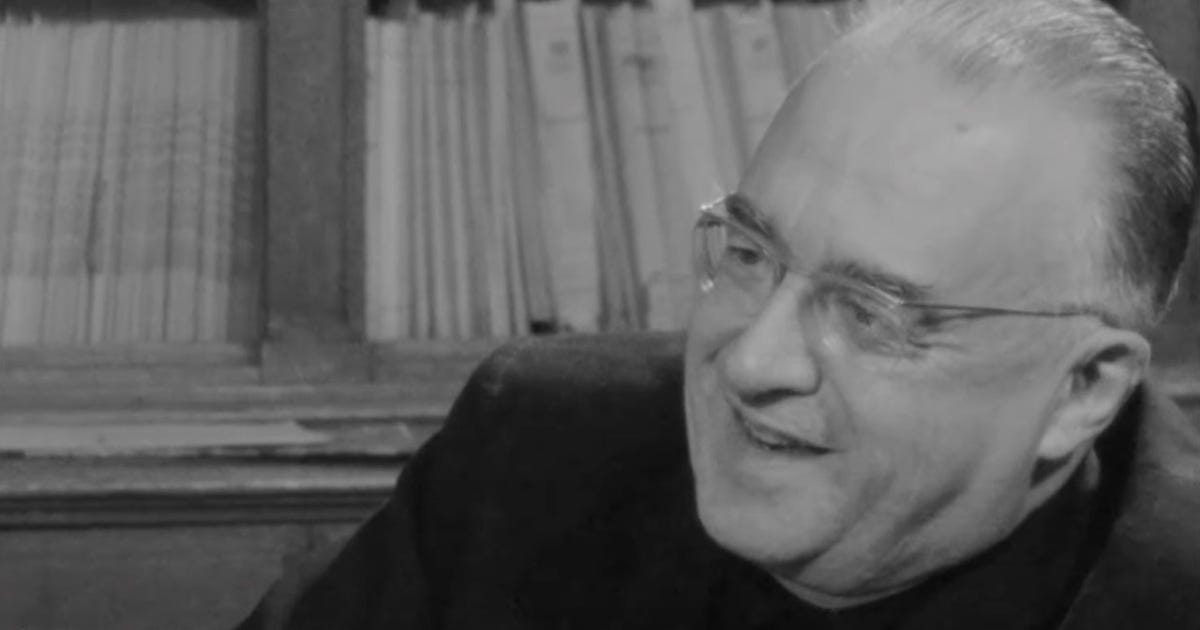
In 1931, a Belgian cosmologist visited Georges Lemaître shocked the astronomy world.
Perhaps, he reasoned in a spicy paper, our utterly massive cosmic expanse might've begun as a singular, teeny tiny point some 14 billion years ago. Yet, he ended, this point probably exploded, eventually stretching out into the ginormous realm we call the universe -- a realm that's unruffled blowing up in every direction as though it were an unpoppable balloon.
If this were true, it'd mean our universe didn't always existed. It'd mean it must've had a beginning.
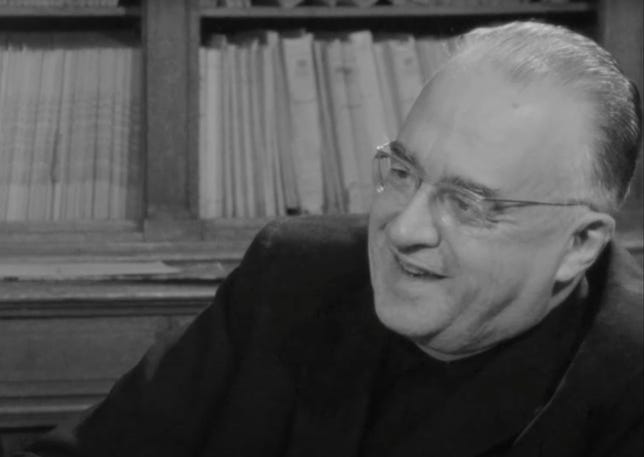
A unruffled from the found footage of Georges Lemaître, father of the Big Bang theory.
VRT/Screenshot by Monisha RavisettiThen, in 1965 -- a year before Lemaître's death -- scientists used the discovery of cosmic microwave background radiation to finally put forth undeniable evidence of this theory.
Today, we call it the Big Bang.
And on December 31, the state public-service broadcaster for the Flemish Community of Belgium -- the Vlaamese Radio- en Televisieomroeporganisatie, or VRT -- recovered something quite remarkable.
It's thought to be the only video of Lemaître in existence.
Better yet, this treasured roll of footage, which aired in 1964, is of an interview with the esteemed physicist where he discusses what he periods the "primitive atom hypothesis," aka the basis of his iconic Big Bang theory.
"The file for the film turned out to be misclassified and Lemaître's name had been misspelled," Kathleen Bertrem, a member of the VRT archives, said in a statement. "As a result, the interview remained untraceable for years." But one day, when a staff member was scanning a few rolls of film, he suddenly known Lemaître in the footage and realized he'd struck gold.
The interview itself was conducted in French -- and is available with Flemish subtitles if you want to look it online -- but in an effort to make the film more broadly available, experts published a paper this month that provides an English translation of the nearly 20-minute clip.
"Of all the country who came up with the framework of cosmology that we're employed with now, there's very few recordings of how they talked around their work," Satya Gontcho A Gontcho, a scientist at the Department of Energy's Lawrence Berkeley National Laboratory Berkeley Lab who led the translation, said in a statement. "To hear the turns of clause and how things were discussed … it feels like peeking over time."
Reading through the entire discussion is actually quite trippy. It's incredible to see what a scientist said, verbatim, about the ideas that would eventually change the streams of history, of physics, and even of human perspective.
It's also quite striking how definite, cogent and modern the discussion sounds. Almost like a podcast.
"A very long time ago, beforehand the theory of the expansion of the universe (some 40 ages ago)," Lemaître tells an interviewer, per the transcript, "we predictable the universe to be static. We expected that nothing would change."
He remains to call such a concept an a priori idea, message no one actually had any experimentalevidence to prove how the make of space and time was truly static. Yet, as Lemaître says (and we now know for certain) many evidentiary facts support the expansion of the universe.
"We realized that we had to admit change," he said. "But those who wished for there to be no change… in a way, they would say: 'While we can only admit that it moves, it should change as little as possible.'"
On this lead, Lemaître points out the beliefs of astronomer Fred Hoyle, who at the time had firmly promoted the fact that our universe is "immutable," or happy. Hoyle, fascinatingly, was also the first person to use the terminology "big bang" to portray what Lemaître proposed, but he did it with the cadence of mockery. Nonetheless, the name stuck.
This isn't to say no one supported the universe expansion theory.
A solid number of physicists did, counting most notably, Albert Einstein and Edwin Hubble (yes, the Hubble Space Telescope's namesake). It was, in fact, Hubble who'd shown the science public why the universe must be expanding in all directions. He'd used a massive telescope in California back in 1929 to describe how distant galaxies were getting farther and farther away from us as time progressed.
In conjunction with Hubble's observations, a 1927 paper written by Lemaître eventually helped convince the most of astronomers our universe is absolutely ballooning outward.
"Lemaître and others gave us the mathematical framework that does the basis of our current efforts to understand our universe," said Gontcho A Gontcho.
For instance, Gontcho A Gontcho also points out how knowing the universe's expansion rate services us study more elusive aspects of the cosmos, such as the big mystery of dark energy.
Weirdly, dark energy seems to be forcing our universe to expand far more fast than it should, even making it go faster and faster as time progresses.
Georges Lemaître (center) is seen here with Albert Einstein as they conferred at the California Institute of Technology. With them is Robert A. Millikan, head of the institute.
Getty ImagesThe additional half of Lemaître's interview focuses not on the scientific implications of his theory but on the philosophical, even religious, implications. In addition to being a famous cosmologist, Lemaître was a renowned Catholic priest.
The interviewer asks him, for instance, whether the idea that the universe must have a start holds any religious significance. Lemaître, in response, simply says, "I am not protecting the primeval atom for the sake of whatever religious ulterior motive."
At this show, though, the cosmologist says further elaboration on the topic can be false in a separate interview. The interviewer pushes a bit, asking Lemaître a ask about how religious authorities might react to his theories.
To this, Lemaître basically touches on how questions around the importance of when, why and how the start of time came to be -- religious or not -- are sort of moot. "The start is so unimaginable," he said, "so different from the describe state of the world that such a question does not arise."
Even if God does theoretically been, he says he doesn't believe a deity's existence would interfere with the scientific nature of big theory.
"If God supports the galaxies, he acts as God," Lemaître said. "He does not act as a made that would contradict everything. It's not Voltaire's watchmaker who has to wind his clock from time to time, isn't it... [laughs]. There!"
Source


